
Rhinestones, Relationships & the Real Scoreboard
What Dolly Can Teach Us About Being, Not Just Doing
Like so many people, I have found myself thinking a lot about Dolly Parton this week. I have watched interviews, read tributes and listened to people from completely different walks of life talk about what she meant to them. And there is one thing I keep coming back to that I honestly find remarkable: I have not seen or heard one negative thing about Dolly Parton.
Think about that for a minute.
We are talking about someone who spent nearly seven decades in the public eye. Someone who was enormously successful, outspoken at times, incredibly wealthy, instantly recognizable and known by multiple generations. We live in a world where we can find something to criticize about almost anyone, and the media certainly isn't known for passing up an opportunity to do it. Yet as I have listened to people talk about Dolly, the stories seem to be remarkably consistent. People talk about her kindness, generosity, humor, humility, faith, authenticity and, maybe most of all, the way she made people feel.
The Associated Press described her as that rare celebrity whose appeal crossed generations, geography and politics, while tributes from around the world have focused again and again on her generosity and humanity.
I honestly can't think of a single public figure for whom that could be said after a lifetime in the spotlight. It feels almost unprecedented!
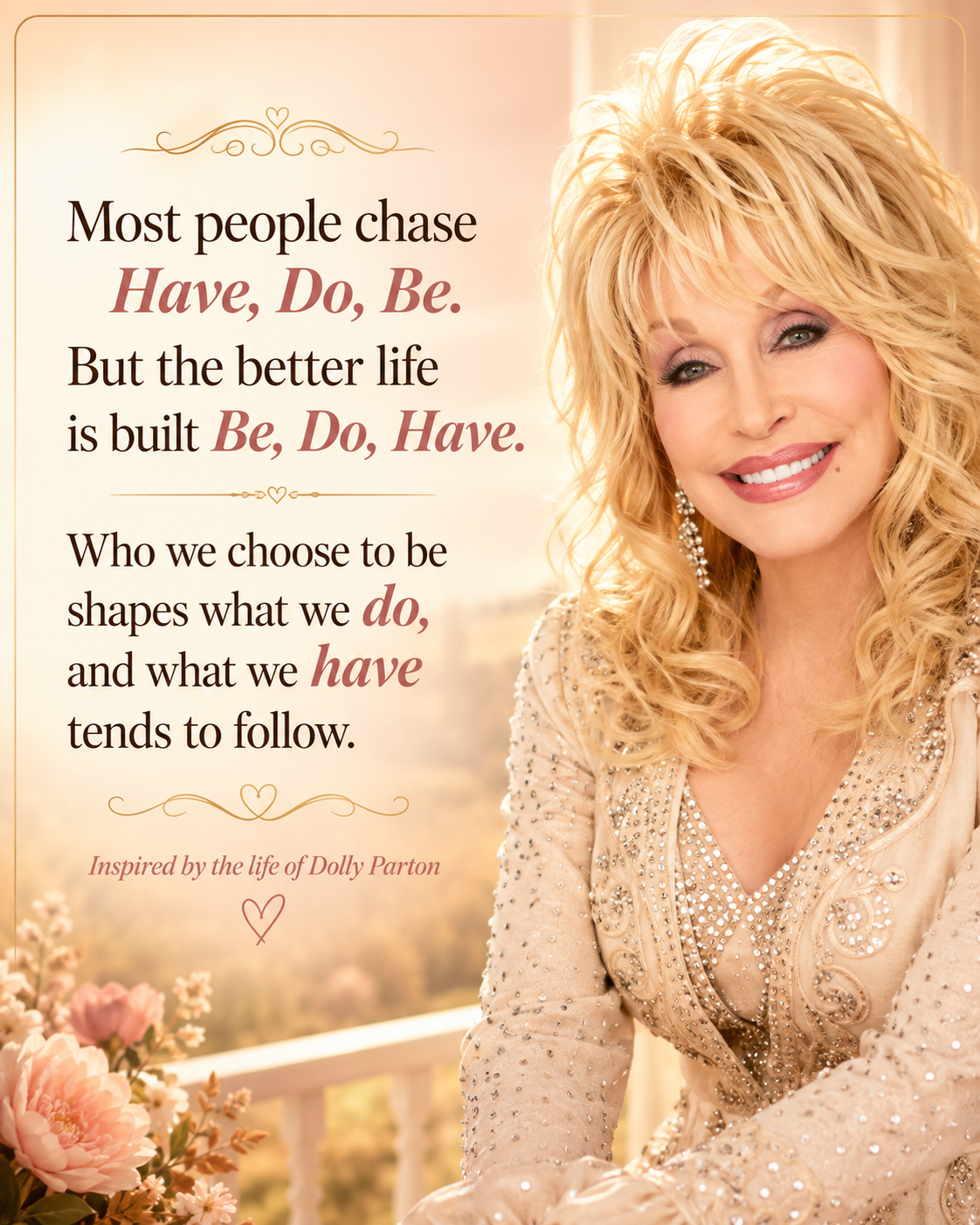
One of the concepts we talk about often here at the Brady Group is "Be, Do, Have". Most of us naturally reverse it. We think, If I can just have the successful practice, the full schedule, the great team, the financial security, then I’ll do the things successful people do, and eventually I’ll become the person I want to be. But lasting change usually works the other way around. We first have to decide who we want to be—more present, more curious, more generous, more accountable, more relational. From that place, we do things differently, and over time, the have tends to follow. Who we are drives what we do, and what we do creates what we have—not the other way around.
And that has made me think less about everything Dolly Parton did and much more about who she chose to be.
Of course, what she did was extraordinary. She wrote thousands of songs, built businesses, created Dollywood, became one of the most recognizable entertainers in the world and used her success to give back in countless ways, including putting millions of books into the hands of children through her Imagination Library.
By anyone's definition, Dolly got a whole lot done. But when a life ends, it is interesting what people remember. They aren't primarily talking about her productivity. They are talking about the experience of being around her. And I think there is something in that for all of us.
We Are Really Good at Doing
Dentistry gives us plenty to do. There are patients to see, schedules to fill, numbers to hit, treatment to complete, calls to return, systems to follow, team members to train and about a hundred things happening at once on any given day.
Of course those things matter. I believe in strong systems, accountability, great dentistry, healthy production and profitability. I spend a whole lot of my life talking about those things.
But I also believe we can become so focused on what we are trying to accomplish that we forget to pay attention to who we are being while we accomplish it.
That distinction matters because you can have great systems and still have a practice where people don't enjoy coming to work. You can hit a production goal and have a team that doesn't trust one another. You can have an incredibly efficient new-patient process and still make the patient sitting in front of you feel like the next item on your list.
I often say People > Projects - I think this is exactly what that means. The work matters, but the people have to matter more.
It Applies to Every Person in the Practice
Every person in the practice is creating the experience of being there - not just the doctor.
The way the doctor sees the team matters, but so does the way the team sees the doctor. What we say about one another when someone isn't in the room becomes part of the culture just as surely as what is said in a team meeting.
And then there are our patients.
I sometimes think one of the greatest dangers in dentistry is that we know too much about dentistry.
We know what we see on the X-ray. We know what that tooth is likely to do. We know the treatment options. We know how much time is available on the schedule. We know where we would like the conversation to go.
The patient knows something completely different. They know what it feels like to be them.
They know that they are embarrassed because they haven't been to the dentist in eight years. They know that their last dental experience scared them to death. They know that they hate the way their smile looks in pictures. They know that money is tight because their daughter is getting married. They know that their father lost his teeth young and they are terrified the same thing is going to happen to them.
Or maybe they don't know exactly what they want yet. Maybe they just know something isn't right and they came to us hoping someone would care enough to find out.
If we are too busy doing dentistry, we can completely miss the human being who showed up to receive it.
Are We Seeing People, or Are We Seeing Their Function?
I think this can happen so gradually that we don't even notice it.
The hygienist becomes the road to production. The assistant becomes the person responsible for turning the room. The front office becomes the person who is supposed to keep holes out of the schedule. The doctor becomes the producer and the fix-it person.
Patients can become an implant, a crown, a planning appointment, a cancellation or $12,000 of unscheduled treatment.
Those descriptions may tell us something about what is happening in the practice, but they tell us almost nothing about the person.
And that is where relational and transactional really separate from one another.
Transactional thinking starts with, “What do I need to get accomplished here?”
Relational thinking starts with, “Who is this person, and what matters to them?”
That doesn't mean we stop doing our jobs. It doesn't mean we stop providing excellent clinical dentistry, following systems, having expectations or holding one another accountable. It simply means the person stays bigger than the task.
Curiosity Changes the Way We See People
This may be one of the hardest parts, particularly with people we know well.
A patient we have just met still gets some curiosity. A team member we have worked beside for six years? We already have a story about them.
“She always does this.”
“He doesn't care.”
“She is too sensitive.”
“He never listens.”
“She just wants her way.”
As we shared in last week's post, the minute I decide I already know your motive, I don't have much reason to stay curious about you. And I think relationships begin to change when we are willing to consider that there may be more to the story than we know.
Maybe the patient who keeps asking about the cost isn't cheap. Maybe there is something going on financially that they haven't told us.
Maybe the team member who seems distracted isn't disengaged, they're struggling with a relationship at home.
Maybe the doctor who responded abruptly is carrying something none of us know about.
Maybe the person who disagrees with us isn't being difficult. Maybe they see something we don't.
Curiosity doesn't remove accountability, and it doesn't mean every behavior is acceptable. It simply keeps us from turning a human being into the story we have created about them.
That is a very different way to live and work with people.
Dolly Made the Person in Front of Her Matter More Than Anything Else
As I have listened to people tell stories about Dolly, this is the thread I keep hearing. For someone who was one of the most famous women in the world, she apparently had an incredible ability to make other people feel important.
That may be one of the greatest lessons she leaves us.
What if, when we walk into an interaction, the person in front of us really is the most important person in the room for those few minutes?
That might be the patient telling us a long story when we are already running behind. It might be the team member asking a question we think they should already know. It might be the coworker whose personality is very different from ours. It might be the patient who just said, “I want to think about it,” when we were absolutely certain they were going to move forward.
Our instinct is often to respond, explain, correct, fix or convince.
Sometimes what that person needs first is simply to know that we see them.
That is true with our patients. It is true with our teams. And frankly, it is true when we go home at night, too.
Being Doesn't Mean We Stop Doing
I don't want this to be misunderstood as an argument for lowering expectations or spending our days sitting around talking about our feelings.
If you know me, you know better than that!
I want the schedule profitable. I want the systems followed. I want the planning appointments scheduled. I want the numbers on the scoreboard. I want people to follow through on what they said they would do.
But I don't think doing and being are opposites. I think the very best practices learn how to do both.
They pursue excellence while still treating people like people. They hold high expectations while remaining curious. They have difficult conversations without making someone smaller. They recommend excellent dentistry without deciding what the patient should value, but based on the patient's desires. They know their numbers without allowing the numbers to become more important than the humans who create them.
That is a much harder standard than simply getting things done. It also creates a very different kind of practice.
Maybe There Is Another Scoreboard
We love a scoreboard at Brady Group, and I don't plan to stop using one anytime soon. There is tremendous value in knowing where we are and whether what we are doing is working.
But Dolly's life has made me think about another kind of scoreboard, one that isn't quite as easy to measure.
At the end of the day, did our patients feel known, or processed? Did we listen long enough to discover what actually mattered to them, or did we make assumptions because we already knew what we thought they should do?
Did the people on our team feel respected? Did we make it easier or harder for someone to tell us the truth? Did we stay curious when it would have been easier to judge? Did we contribute to the culture we say we want, even when we weren't the person in charge?
And maybe most importantly, were people better because we were there?
I think that question gets pretty close to the heart of what we mean when we say People > Projects.
What Are We Building in People?
Eventually, every schedule gets completed. The month ends. The scoreboard starts over. The dentistry we work so hard to complete will someday be replaced. Even the practices we spend our careers building will eventually belong to someone else.
What we build in people has a much longer life.
Someone may become a more confident team member because we saw something in them before they saw it in themselves. A patient who has spent years embarrassed about their teeth may finally feel safe enough to talk about what they really want. A team member may extend more grace to someone else because grace was once extended to them. A doctor may become a different kind of leader because someone cared enough to tell them the truth and stayed in relationship with them while they grew.
That is influence, and every person in a practice has the ability to have it. Don't think for a minute that just because your name isn't on the door, that you can't influence others.
Dolly Parton leaves behind an extraordinary list of accomplishments. But after almost 70 years in the public eye, perhaps the most extraordinary part of her legacy is that people from seemingly every corner of the world are telling essentially the same story about who she was.
Not perfect. Not superhuman. But kind. Generous. Funny. Grounded. Authentic. Someone who genuinely seemed to like people and who left them feeling better for having crossed her path.
If we can live an entire life and, at the end of it, the overwhelming story people tell isn't simply about what we accomplished but about how we treated them, I think we have done something pretty special.
Tomorrow morning, there will still be plenty to do. There always is.
Maybe the better question isn't whether we will get it all done.
Maybe it is who we will choose to be with the people we encounter while we are doing it.
Dolly Parton's Imagination Library has carried the message, “Dream More. Learn More. Care More. Be More.”
After watching the world remember her this week, I think the last two may be the ones worth holding onto most.
Care more. Be more.
I think Dolly got that right.